The Science Behind Personality Compatibility In Relationships

DateMetriX predicts relationship compatibility using the Jung/Myers-Briggs 16 personality types. This psychometric framework has over 100 years of development and is widely used in organizational psychology and relationship compatibility research.

Personality Compatibility Rating

How Different Personality Types Interact in Relationships

Our personality compatibility rating is based on the Jung/Myers-Briggs 16 personality types. This psychometric test has a long history of development dating back 100 years to Swiss psychiatrist Dr. Carl Jung and his book "Psychologische Typen" which translates to Psychological Types in English. This personality test was later updated by Isabel Briggs Myers and her mother Katherine Briggs. The formal version of the 16 personality types test is known as the Myers-Briggs Type Indicator® and is used primarily to help in organizational psychology.

The DateMetriX personality compatibility algorithm can be used to predict personality compatibility between single people and couples. It works by assigning maximum compatibility scores for similar personality types and less compatibility with personality types that clash.

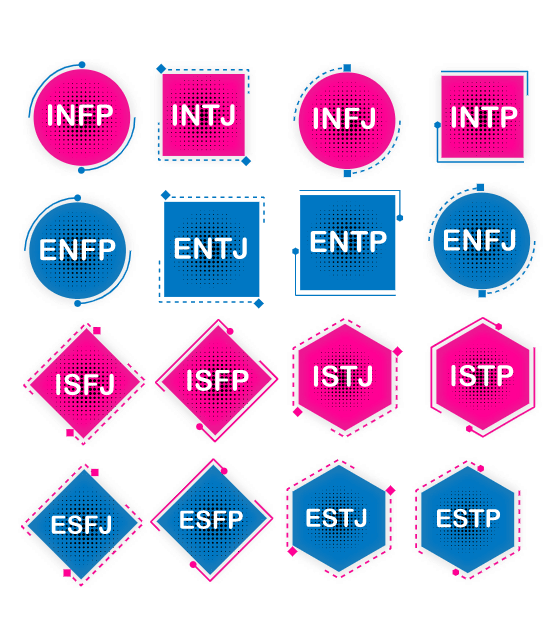
DateMetriX personality compatibility - 16 personality types

Analysts

INTJ, INTP, ENTJ, ENTP — Rational, strategic thinkers who value logic and competence

Sentinels

ISTJ, ISFJ, ESTJ, ESFJ — Practical, dependable types who value stability and tradition

Explorers

ISTP, ISFP, ESTP, ESFP — Spontaneous, energetic types who value freedom and hands-on experience

Diplomats

INFJ, INFP, ENFJ, ENFP — Empathetic, idealistic types who value harmony and personal growth

How Personality Types Predict Compatibility

The Myers-Briggs framework measures personality across four dimensions, each creating natural compatibility patterns in relationships:

  • Extraversion (E) vs. Introversion (I): How you direct and receive energy — from the outer world or inner world
  • Sensing (S) vs. Intuition (N): How you take in information — through concrete facts or abstract patterns
  • Thinking (T) vs. Feeling (F): How you make decisions — through logic or personal values
  • Judging (J) vs. Perceiving (P): How you organize your life — through structure or flexibility

Research shows that certain combinations of these preferences lead to more harmonious relationships, while others require more effort. DateMetriX's algorithm weighs these interactions to predict overall compatibility.

Stable Matching Algorithm

2012 Nobel Prize in Economics

DateMetriX employs the Gale-Shapley algorithm, a Nobel Prize-winning mathematical approach to stable matching. In 2012, Lloyd Shapley and Alvin Roth received the Nobel Memorial Prize in Economic Sciences "for the theory of stable allocations and the practice of market design."

The algorithm ensures that matches are stable, meaning no two people would rather be with each other than their current matches. This creates better long-term satisfaction and reduces match churn.

DateMetriX combines this mathematically-proven matching approach with personality science to deliver optimized matches that maximize both psychological compatibility and relationship stability.

Nobel Prize 2012 Mathematically Proven

Key Research Papers

Personality Types

Our personality compatibility rating is based on the Myers-Briggs 16 personality types. This test has a long history with the development of the first 3 components dating back almost 100 years to Dr. Carl Jung and today the 4 letters and 16 personality type groups are widely known to the majority of people. DateMetriX's personality compatibility algorithm puts maximum weight on similar personality types and less weight towards personality types that tend to clash.

Lok C (2012) Career development: What's your type? Nature, 488: 545-547

Keirsey, D (2006) Please Understand Me II (3rd ed). Prometheus Nemesis Book Co., Del Mar, CA.

Myers IB, McCaulley MH, Quenk NL and Hammer AL (1998) MBTI manual: A guide to the development and use of the Myers-Briggs Type Indicator. Consulting Psychologists Press, Palo Alto, CA, Vol. 3.

Myers IB, McCaulley MH and Most R (1985) Manual, a guide to the development and use of the Myers-Briggs type indicator. Consulting Psychologists Press.

Jung CG (1923) Psychological types: or the psychology of individuation. Oxford, England: Harcourt, Brace.

Discover Your Personality Compatibility

Take our personality assessment and discover your compatible matches based on the Myers-Briggs 16 personality types.

See Your Personality Matches Take A Free Personality Test